Showing posts with label Toho. Show all posts

Monday, March 12, 2012

"50 Reasons Why Tokyo Is The Greatest City In The World"

by Armand Vaquer

Above, the Tsukiji Fish Market. Photo by Armand Vaquer.

Along with the Wako Department Store in Ginza, the National Diet Building, the Yurakucho Mullion complex and other kaiju-related sites featured in The Monster Movie Fan's Guide To Japan, Tokyo has other things for travelers to see and do.

CNN Go.com has a list of "50 Reasons Why Tokyo Is The Greatest City In The World."

Included on the list are the railways, Tokyo Sky Tree, Shibuya Crossing (featured in Godzilla and Gamera movies), Imperial Palace, Yodobashi Akiba (and other Akihabara electronics stores), Tsukiji Fish Market, Mandarake Complex, manga-kissa (or "comics café") and many others.

The Godzilla statue in Hibiya made the list:


34. Behold the least impressive statue of a giant monster

Standing in the shadow of the film company that unleashed Godzilla on the world, this bronze effigy of the giant creature in Hibiya park towers a whopping ... half-meter high. We suppose a life-sized 70-meter version would have been prohibitive, but half a meter? At least the pedestal raises it above eye level.


At least there's the man-sized Godzilla statue at Toho Studios to savor if the one in Hibiya doesn't impress.

To view the list, go here.

Thursday, December 15, 2011

KING KONG ESCAPES - Did You Know?

Trivia Compiled By: Ken Hulsey
Sources: IMDB / Wikipedia

Japanese film makers have been obsessed with "King Kong" since his first screen appearance in 1933. Almost immediately "Kong" inspired films began popping up in theaters throughout the land of the rising sun. Unfortunately these films are lost and mostly forgotten.

A couple of decades later when Tomoyuki Tanaka was looking to make a monster film of his own after seeing "The Beast From 20,000 Fathoms" the idea for a Japanese "King Kong" film would be revisited. Most people never knew that originally "Godzilla" wasn't going to be a dinosaur at all but a fire-breathing gorilla. Alas it's true. Of course that idea, plus the idea of making "Big G" a giant octopus, was scrapped for what would become everyone's favorite mutant behemoth, which ultimately proved to be a far better choice.

Who in the hell would want to see a giant fire-breathing gorilla movie? Okay, maybe I would but most people wouldn't.

Toho would eventually make two "King Kong" films, one being "King Kong vs Godzilla" and the other "King Kong Escapes". Despite what a lot of people believe the two films are in no way connected to each other in any way. That is to say "KK Escapes" is not a sequel to "KK vs G".

As many of you may know December is my birthday month and 1967 is my birthday year so I figured I would post about my favorite monster film from that year "King Kong Escapes".

Did You Know?

Two costumes of King Kong were made. The arms of the first costume were very long, so Haruo Nakajima's hands did not reach those of the costume. He had to grasp onto sticks that were attached to the hands of the costume. He wore a second costume with shorter arms whenever they were shooting footage of King Kong battling other monsters.

The way Kong kills Gorosaurus, by splitting his jaws apart, is the same way the original Kong kills the tyrannosaurus in the original King Kong.

Even though Linda Miller was an American that spoke fluent English, her voice was dubbed by Julie Bennett.

This film was a live action tie-in to the animated TV series King Kong, which was also produced by Rankin/Bass Productions.

In the film, Doctor Hu is trying to get some Element X by digging into the land under the ice at the North Pole. There is no land under the North Pole, but there is a lot of it under the South Pole.

During some of the North Pole scenes, Dr. Hu's men cast shadows on the painting of the "distance" (mainly snow-capped mountains) on the studio set.

The film opened in the United States in June 1968 on a double-bill with the Don Knotts comedy The Shakiest Gun in the West Contemporary American reviews were mixed. New York Times film critic Vincent Canby gave it a particularly insulting review, commenting, "The Japanese...are all thumbs when it comes to making monster movies like 'King Kong Escapes.' The Toho movie makers are quite good in building miniature sets, but much of the process photography—matching the miniatures with the full-scale shots—is just bad...the plotting is hopelessly primitive..."

Outside of the Japan and the U.S, the film received a wide release in most International markets where it went by different titles. The film was released in Germany as King-Kong, Frankensteins Sohn (King Kong: Frankenstein's Son), in Belgium as La Revanche de King Kong (The Revenge of King Kong), in Italy as King Kong il gigante della foresta (King Kong, The Giant of the Forest), in Turkey as Canavarlarin Gazabi (Wrath of the Monsters), in Mexico as El Regreso de King Kong (The Return of King Kong), in Finland as King Kong kauhun saarella (King Kong on the Island of Terror), and in Sweden as King Kong skräckens ö (King Kong on Terror Island)

Toho had wanted to use King Kong again after this film. King Kong was included in an early draft for the 1968 film Destroy All Monsters but was ultimately dropped due to the fact that Toho's licence on the character was set to expire. Toho managed to get some use out of the suit though. The suit was reused to play the character "Gorilla" in episode #38 of the Toho giant superhero show Go! Greenman. The 3 part episode titled Greenman vs. Gorilla aired from March 21, 1974 through March 23, 1974.

Toho would bring the character Gorosaurus into the Godzilla series in the 1968 film Destroy All Monsters using the same suit from this film. The suit was reused again four years later (at this point in dilapidated condition) to portray the character in episode #6 of the Toho giant superhero show Go! Godman. The 6 part episode titled Godman vs. Gorosaurus aired from November 9, 1972 through November 15, 1972.

In the early 1990s when plans for a King Kong vs Godzilla remake fell through, Toho had planned to bring back Mechani-Kong as an opponent for Godzilla in the project Godzilla vs. Mechani-Kong. However, according to Koichi Kawakita, it was discovered that obtaining permission even to use the likeness of King Kong would be difficult. Kawakita stated, Toho wanted to pit Godzilla against King Kong because King Kong vs. Godzilla was very successful. So, it instead decided to use MechaniKong. Soon afterward, it was discovered that obtaining permission even to use the likeness of King Kong would be also as difficult. So, the project was canceled.

The shot of Gorosaurus living on Monster Island seen in the 1969 film All Monsters Attack was actually stock footage taken from this film.

The July 15, 1968, issue of Film Bulletin, however, gave it a more positive review, saying, "Grown-ups who like their entertainments on a comic-strip level will find this good fun and the Universal release (made in Japan) has plenty of ballyhoo angles to draw the school-free youngsters in large numbers."

And Now You Know!

Wednesday, December 7, 2011

Honda Estate vs. Toho: More Information

by Armand Vaquer


Here's a few more details (and confirmation that there is a legal action pending) from Godzilla historian Ed Godzisewski (right) that was posted at the Monster Zero message board:

Yes, there is a legal case ongoing in Japan. Has been for a while. I have heard about the case from Ryuji for a couple years. The family has preferred to just quietly pursue the case the way it should be done, in court. It all stems from the Japanese system that gives rights to writers (not directors).

The first ruling is due in February.


Looks like we won't have to wait too long.

Honda Estate vs. Toho: More Information

by Armand Vaquer


Here's a few more details (and confirmation that there is a legal action pending) from Godzilla historian Ed Godzisewski (right) that was posted at the Monster Zero message board:

Yes, there is a legal case ongoing in Japan. Has been for a while. I have heard about the case from Ryuji for a couple years. The family has preferred to just quietly pursue the case the way it should be done, in court. It all stems from the Japanese system that gives rights to writers (not directors).

The first ruling is due in February.


Looks like we won't have to wait too long.

Monday, December 5, 2011

Honda Estate vs. Toho: Delving Deeper

by Armand Vaquer

Above, the Godzilla statue at Toho Studios. Photo by Armand Vaquer.

The story of the alleged lawsuit by the family of late director Ishiro Honda against Toho Co., Ltd. over the Godzilla copyright may have some legs after all.

Over on Facebook, some of us were mulling over the story.

It was asked by one participant: "Couldn't we have somebody in Japan verify if a Complaint has actually been filed? Those are a matter of public record·"

Noted Godzilla historian August Ragone replied that he had looked into it and he is currently "writing up something about this now [for his blog]."

Once he does, I'll post a link to his blog post. This should be interesting!

It appears we may be on the verge of learning something about Japanese copyright law.

Honda Estate vs. Toho: Delving Deeper

by Armand Vaquer

Above, the Godzilla statue at Toho Studios. Photo by Armand Vaquer.
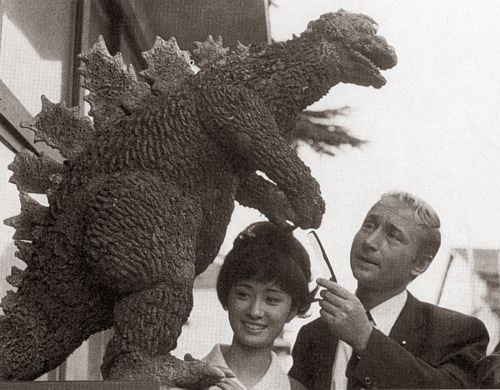
The story of the alleged lawsuit by the family of late director Ishiro Honda against Toho Co., Ltd. over the Godzilla copyright may have some legs after all.

Over on Facebook, some of us were mulling over the story.

It was asked by one participant: "Couldn't we have somebody in Japan verify if a Complaint has actually been filed? Those are a matter of public record·"

Noted Godzilla historian August Ragone replied that he had looked into it and he is currently "writing up something about this now [for his blog]."

Once he does, I'll post a link to his blog post. This should be interesting!

It appears we may be on the verge of learning something about Japanese copyright law.

Sunday, December 4, 2011

Honda Estate vs. Toho Ramifications?

by Armand Vaquer

Above, yours truly with the Godzilla statue at Toho Studios.

The story of the alleged copyright lawsuit against Toho by the heirs of Ishiro Honda over the Godzilla character may have some big ramifications if 1.) the story is true or, 2.), they actually win.

The story does not sound Japanese to me. Maybe in America, perhaps (i.e., Bela Lugosi Jr.'s legal actions over his father's image and The Three Stooges).

If the story is true and Honda's heirs prevail and win the Godzilla copyright from Toho, could we see Noriaki Yuasa's estate taking similar action against Kadokawa Pictures (the successor company to Daiei) over the Showa Gamera and Shusuke Kaneko over the Heisei Gamera? Who knows what (or who) may come out of the woodwork?

It will be interesting to see how this plays out, if true.

Honda Estate vs. Toho Ramifications?

by Armand Vaquer

Above, yours truly with the Godzilla statue at Toho Studios.

The story of the alleged copyright lawsuit against Toho by the heirs of Ishiro Honda over the Godzilla character may have some big ramifications if 1.) the story is true or, 2.), they actually win.

The story does not sound Japanese to me. Maybe in America, perhaps (i.e., Bela Lugosi Jr.'s legal actions over his father's image and The Three Stooges).

If the story is true and Honda's heirs prevail and win the Godzilla copyright from Toho, could we see Noriaki Yuasa's estate taking similar action against Kadokawa Pictures (the successor company to Daiei) over the Showa Gamera and Shusuke Kaneko over the Heisei Gamera? Who knows what (or who) may come out of the woodwork?

It will be interesting to see how this plays out, if true.

Saturday, December 3, 2011

Ishiro Honda Family Suing For Godzilla Copyright

by Armand Vaquer

Above, yours truly with Toho's (or is it Honda's?) copyrighted Godzilla character.

It has been reported that the family of Godzilla director Ishiro Honda is suing Toho Co., Ltd. for the copyright to the Godzilla character.

According to this article in Ridersrangersandrambles.com:

In a past case, the copyright for Godzilla was supposed to belong to the Honda estate, but Toho insists on having at least the merchandising rights to the character.


Personally, I don't see how Ishiro Honda or his family has any claim to the rights to the character as Honda was a staff director of Toho, unless there is some codicil in his contract with the movie studio giving him some rights. Then again, there may be something in Japanese law or case law that provides this.

To read the full article (with links to Japanese sites), go here.

Ishiro Honda Family Suing For Godzilla Copyright

by Armand Vaquer

Above, yours truly with Toho's (or is it Honda's?) copyrighted Godzilla character.

It has been reported that the family of Godzilla director Ishiro Honda is suing Toho Co., Ltd. for the copyright to the Godzilla character.

According to this article in Ridersrangersandrambles.com:

In a past case, the copyright for Godzilla was supposed to belong to the Honda estate, but Toho insists on having at least the merchandising rights to the character.


Personally, I don't see how Ishiro Honda or his family has any claim to the rights to the character as Honda was a staff director of Toho, unless there is some codicil in his contract with the movie studio giving him some rights. Then again, there may be something in Japanese law or case law that provides this.

To read the full article (with links to Japanese sites), go here.

Friday, September 30, 2011

10th Anniversary of First Japan Trip

by Armand Vaquer

Above, Armand with the Godzilla statue in Hibiya. Photo courtesy of Richard Pusateri.

Ten years ago this coming Halloween (October 31), I arrived at the United Airlines Los Angeles International Airport (LAX) terminal for my first trip to Japan. Up to that point, my only "foreign" travels consisted of automotive crossings of the Canadian and Mexican borders from the United States.

October 31 of 2001 was an uneasy time. The September 11 terrorist attacks on the World Trade Center in New York and the Pentagon in Washington, D.C. were still fresh in peoples' minds. The National Guard posted armed (some say the rifles weren't loaded) guardsmen in airport terminals around the country. LAX was no exception. Security was (and still is) extremely tight at airports.

Above, Richard and Armand with Haruo Nakajima at the Tokyo International Film Festival. Photo courtesy of Richard Pusateri.

But, I wasn't about to let this heightened security stop me from making my first overseas visit to another country, even though my mother really didn't want me to go. As Japan is 17 hours ahead of Los Angeles time, I arrived at Narita Airport on November 1 (the International Dateline is crossed in the mid-Pacific).

The year before, fellow G-fan Richard Pusateri took a trip to Japan to see Godzilla x Megaguirus. After hearing his tales of adventure and grand time he had upon his return, I got the urge to go to Japan myself. Luckily, I was working as a temp at a Farmers Insurance claims office and security patrol at the time, so I was able to afford a Japan trip. All I had to do was to get a U.S. Passport, plane ticket and hotel reservations. In rapid order, all were obtained.


The 2001 Tokyo International Film Festival was featuring the premiere of Godzilla, Mothra and King Ghidorah: Giant Monsters All-out Attack on November 3. So, I decided to time my visit for that. As it happened, Richard was also planning to attend and we met several times at Chili My Soul in Encino to plan the trip. At least I would know somebody while there (other familiar names and faces were also there, it turned out).

Since I was writing for G-FAN at the time, I was also able to obtain a press pass for the Godzilla screening. This allowed me access to the stage for the pre-movie festivities (below).


Following the movie, Richard and I rubbed shoulders with Haruo Nakajima, Hideyo Amamoto, Shogo Tomiyama and others.

Above, Godzilla prop at Toho Studios. Mothra rests nearby on a shelf. Photo courtesy of Richard Pusateri.

I was invited to take a V.I.P. tour at Toho Studios while in Japan and was able to invite Richard along. Fortunately, 2001 wasn't 2005, when Toho began demolishing the big pool and several of their old sound stages and facilities, so we were able to see the studio as it was when Eiji Tsuburaya and Ishiro Honda were making movies. One of the things we were greatly impressed with was Toho's old snack bar. It was like stepping back 40+ years in time. Unfortunately, the snack bar is now history. We were shown the studio by Executive Producer Shogo Tomiyama, spfx director Koichi Kawakita and Shozo Watanabe of Toho International following lunch in Hibiya.

For my first visit to Japan, I decided to stay at a ryokan (Japanese inn) to see what it would be like. It was an enjoyable experience (plus the room was cheaper in price). The ryokan was the Hotel Fukudaya in the Shibuya ward of Tokyo. The Tokyo International Film Festival would be screening the Godzilla movie at Orchard Hall in the Bunkamura in Shibuya, within walking distance.

Above, Godzilla entertains attendees of the film festival. Photo by Armand Vaquer.

The Hotel Fukudaya was also a couple of blocks away from a Denny's Restaurant (it was a surprise seeing Denny's in Japan). While I like Japanese food, I prefer to have a western-style breakfast. Denny's came in handy for that.

Above, Atami, Japan. Photo by Armand Vaquer.

My wanderings in Tokyo on that first trip included Ginza, Hibiya, the Imperial Palace, Tokyo Tower, the National Diet Building, Harajuku, Zojo-ji Temple, Shibuya, Shinjuku and Nakano (where I bought a few things from the Mandarake store). Outside of Tokyo, I visited Atami and some areas near Mt. Fuji. After all, I just had to include some Shinkansen (bullet train) traveling experience on the trip!

I also visited the HMV video and record store in Shibuya to see the Godzilla and Baragon filming suits from GMK on display.

One thing that was not planned was a 24-hour flu bug I caught. Thank goodness it only affected roughtly one day of the trip. Since then, I make sure I take Vitamin C tablets every day for about two weeks before a trip and continue taking them during the trip. (I have been back to Japan five more times and have not gotten sick since I started the Vitamin C regimen. This is a word to the wise!)

Above, with Shogo Tomiyama (far left) and Koichi Kawakita (far right) at Toho Studios. Photo courtesy of Richard Pusateri.

Besides the jaunts around Tokyo, Mt. Fuji and Atami, I attended an after-premiere dinner party at a Chinese restaurant in Nakano that included Kenpachiro Satsuma and Hiroko Sakurai. It was interesting riding shotgun in a taxi on a rainy night as the driver zig-zagged through traffic (Japanese cars have the driver on the right, just as in England) on Tokyo's side streets to get to the dinner party.

Above, the Nijubashi Bridge at the Imperial Palace in Tokyo. Photo by Armand Vaquer.

This was the trip that started me on the kaiju location article series for G-FAN and, eventually, The Monster Movie Fan's Guide To Japan.

For me, it was a memorable trip and a highly enjoyable one. I decided then that I would re-visit Japan as often as time (and the ol' wallet) will allow. It is hard to believe that ten years has already passed since this trip. The next time I traveled to Japan was with the first G-TOUR in August 2004. I've returned there four more times (2005, 2006, 2007 and 2010).

Friday, September 9, 2011

PRESERVING GODZILLA


Ten years ago, I wrote the following article on Toho's efforts to preserve their film library of kaiju movies for G-FAN magazine (issue no. 48). I thought now would be a good time for a revisit.

by Armand Vaquer

Do you wonder if Godzilla will be around for future generations to enjoy? This thought occurred to me when I set out to check on the state of Toho’s classic Godzilla films and what efforts are being made to ensure that the “King of the Monsters” will be around for generations to come.

I recently checked on the subject of film preservation and restoration with the American Film Institute (AFI) and found that our film heritage is in pretty good shape, at least for now. The thought also occurred to me, “ What is being done in Japan by Toho Co., Ltd. in preventing film deterioration?” I will state my findings herein.

Background.

As many of you motion picture fans know, film deterioration has been a major concern during the past several years. Many studios and the American Film Institute have in place programs to restore, preserve and protect films of varying ages and film types.

Several years ago, concern was raised over the loss of films before 1951 that were on nitrate-based film stock. Nitrate film stock turned out to be unstable, flammable and deteriorates after several years. When it was realized that we were losing our old films, efforts began to transfer these films from nitrate stock to modern safety film. Thanks to these efforts, older nitrate films were saved and not lost to the ages as some had already been.

Another concern was that color films were deteriorating (even though they were on safety film) because of the single strip film emulsion also proved to be unstable. It has been learned from bitter experience that unlike the earlier three-strip Technicolor film process, today’s color film can fade irretrievably in as little as five years (note that Lucasfilm had to restore the earlier “Star Wars” films before they could be re-released just prior to the release of “The Phantom Menace”).

According to the AFI, “There is no practical solution for preserving the color in single-strip emulsion safety film.”

Then there’s also “The Vinegar Syndrome.” Modern safety film bases are composed of either acetyl cellulose (triacetate) or polyester (product names “Estar” or “Cronar”). When exposed to flame, modern safety film will only curl and extinguish itself. When modern safety film is properly stored, it should not decompose over time and is estimated to have a shelf life about as long as that of good quality paper, approximately 200 to 300 years. Shrinkage and brittleness will also be minimized in films that are properly stored.

However, during the past several years, archivists and technical experts have learned that triacetate film is not always as stable as was originally thought. Acetate degradation has been identified as a new and potentially serious problem for preservationists. Commonly referred to as “the vinegar syndrome” (because of a vinegar-like odor is given off by deteriorating acetate), acetate degradation proceeds in a way not dissimilar to nitrate deterioration, but without the flammability factor. This problem has proven to be especially serious in films improperly stored in high temperature and humidity environments. It is also believed to be contagious, that degrading acetate can infect other films stored in the same area.

Toho’s film library.

Fortunately for us kaijulogists, although there had been kaiju eiga films ("Godzilla", 1954 and "Godzilla Raids Again", 1955) made with nitrate-based film stock, Toho had transferred all original nitrate films to non-flammable safety film. Therefore, no Toho Co., Ltd. kaiju films have been lost due to nitrate deterioration. Like the United States film industry, the Japanese film industry ceased using nitrate-based film stock and started using safety film in the late 1950s.

What of the Godzilla color films? Toho reports that they have the original negatives/master materials of their kaiju eiga films in their best possible conditions. Toho has been aware of the “vinegar syndrome” and has been paying due attention to temperature/humidity control of their film vaults. This has been perfected by Toho’s introduction of their new storage facility for original negatives with a more advanced temperature and humidity control system, called PPM Centre, three years ago.

According to Stuart Galbraith’s book, “Monsters Are Attacking Tokyo!,” Toho primarily used Eastman Color for their color kaiju eiga films. So it appears that the three-strip Technicolor process was never used for their films. U.S. releases of some films ("King Kong vs. Godzilla" (1963) for example) were printed in Technicolor.

On the video and DVD road.

The advent of home video (originally in Beta and VHS formats) in the 1980s allowed Godzilla fans to collect their favorite kaiju films. Often these mass-produced videos had picture qualities that varied as much as the designs of Toho’s monsters. Everyone is pretty much in agreement that the video quality depended upon the original source material.

For example, some companies (Simitar, for one) released video tapes of the classic (or Showa) Godzilla films and often the film prints used left much to be desired. It was through either indifference or economy that this is the case. Many of the video tapes that I have purchased had faded images, choppy editing or horrible sound. Then there are other video distributors who had an excellent print to work with and therefore produced a fine video. Some companies issued videos in EP (extended play) speed that would accentuate an already bad print.

With the introduction of digital DVD in the 1990s, kaiju collectors are able to enjoy superior video and sound on their players. Most, if not all, Heisei series Godzilla films are starting to be released in DVD. This allows for a superior product to be produced before film deterioration to sets in. [Note: Godzilla movies are now starting to be released on Blu-ray. - A.]

At present, there are no programs at Toho to restore their older kaiju films a la Lucasfilm and others. This may be due to the costs involved (in the U.S., AFI reports that the cost to preserve color images can easily be $40,000 per feature-length film), the quality of negatives and storage facilities involved. I have a copy of “Godzilla vs. Ebirah” that has excellent color images, and that film is around 35 years old. I have also seen different prints of “King Kong vs. Godzilla” (1962) and each one had color images that looked as though the film was made this year or pretty close to it.

At present, according to AFI, the only cost-effective means of dealing with color fading is to slow it down by storing color films in vaults designed to maintain below-freezing temperatures and low humidity. This is a stopgap measure. While cold storage may prolong the life of color films, it cannot ensure their survival until the time when it may be possible to transfer the images to an archivally stable medium. It was hoped that digital archiving would accomplish this, but it appears that digital images may not be as perpetually stable as was originally thought or hoped for. The jury is still out on this aspect and it depends upon whom you talk to.

But for the short term at least, we can still enjoy vibrant images of Godzilla in his nearly five decade long adventures.

Sources: American Film Institute, Toho Co., Ltd. (L.A.) and “Monsters Are Attacking Tokyo!” by Stuart Galbraith IV.

©2000 Armand Vaquer

PRESERVING GODZILLA


Ten years ago, I wrote the following article on Toho's efforts to preserve their film library of kaiju movies for G-FAN magazine (issue no. 48). I thought now would be a good time for a revisit.

by Armand Vaquer

Do you wonder if Godzilla will be around for future generations to enjoy? This thought occurred to me when I set out to check on the state of Toho’s classic Godzilla films and what efforts are being made to ensure that the “King of the Monsters” will be around for generations to come.

I recently checked on the subject of film preservation and restoration with the American Film Institute (AFI) and found that our film heritage is in pretty good shape, at least for now. The thought also occurred to me, “ What is being done in Japan by Toho Co., Ltd. in preventing film deterioration?” I will state my findings herein.

Background.

As many of you motion picture fans know, film deterioration has been a major concern during the past several years. Many studios and the American Film Institute have in place programs to restore, preserve and protect films of varying ages and film types.

Several years ago, concern was raised over the loss of films before 1951 that were on nitrate-based film stock. Nitrate film stock turned out to be unstable, flammable and deteriorates after several years. When it was realized that we were losing our old films, efforts began to transfer these films from nitrate stock to modern safety film. Thanks to these efforts, older nitrate films were saved and not lost to the ages as some had already been.

Another concern was that color films were deteriorating (even though they were on safety film) because of the single strip film emulsion also proved to be unstable. It has been learned from bitter experience that unlike the earlier three-strip Technicolor film process, today’s color film can fade irretrievably in as little as five years (note that Lucasfilm had to restore the earlier “Star Wars” films before they could be re-released just prior to the release of “The Phantom Menace”).

According to the AFI, “There is no practical solution for preserving the color in single-strip emulsion safety film.”

Then there’s also “The Vinegar Syndrome.” Modern safety film bases are composed of either acetyl cellulose (triacetate) or polyester (product names “Estar” or “Cronar”). When exposed to flame, modern safety film will only curl and extinguish itself. When modern safety film is properly stored, it should not decompose over time and is estimated to have a shelf life about as long as that of good quality paper, approximately 200 to 300 years. Shrinkage and brittleness will also be minimized in films that are properly stored.

However, during the past several years, archivists and technical experts have learned that triacetate film is not always as stable as was originally thought. Acetate degradation has been identified as a new and potentially serious problem for preservationists. Commonly referred to as “the vinegar syndrome” (because of a vinegar-like odor is given off by deteriorating acetate), acetate degradation proceeds in a way not dissimilar to nitrate deterioration, but without the flammability factor. This problem has proven to be especially serious in films improperly stored in high temperature and humidity environments. It is also believed to be contagious, that degrading acetate can infect other films stored in the same area.

Toho’s film library.

Fortunately for us kaijulogists, although there had been kaiju eiga films ("Godzilla", 1954 and "Godzilla Raids Again", 1955) made with nitrate-based film stock, Toho had transferred all original nitrate films to non-flammable safety film. Therefore, no Toho Co., Ltd. kaiju films have been lost due to nitrate deterioration. Like the United States film industry, the Japanese film industry ceased using nitrate-based film stock and started using safety film in the late 1950s.

What of the Godzilla color films? Toho reports that they have the original negatives/master materials of their kaiju eiga films in their best possible conditions. Toho has been aware of the “vinegar syndrome” and has been paying due attention to temperature/humidity control of their film vaults. This has been perfected by Toho’s introduction of their new storage facility for original negatives with a more advanced temperature and humidity control system, called PPM Centre, three years ago.

According to Stuart Galbraith’s book, “Monsters Are Attacking Tokyo!,” Toho primarily used Eastman Color for their color kaiju eiga films. So it appears that the three-strip Technicolor process was never used for their films. U.S. releases of some films ("King Kong vs. Godzilla" (1963) for example) were printed in Technicolor.

On the video and DVD road.

The advent of home video (originally in Beta and VHS formats) in the 1980s allowed Godzilla fans to collect their favorite kaiju films. Often these mass-produced videos had picture qualities that varied as much as the designs of Toho’s monsters. Everyone is pretty much in agreement that the video quality depended upon the original source material.

For example, some companies (Simitar, for one) released video tapes of the classic (or Showa) Godzilla films and often the film prints used left much to be desired. It was through either indifference or economy that this is the case. Many of the video tapes that I have purchased had faded images, choppy editing or horrible sound. Then there are other video distributors who had an excellent print to work with and therefore produced a fine video. Some companies issued videos in EP (extended play) speed that would accentuate an already bad print.

With the introduction of digital DVD in the 1990s, kaiju collectors are able to enjoy superior video and sound on their players. Most, if not all, Heisei series Godzilla films are starting to be released in DVD. This allows for a superior product to be produced before film deterioration to sets in. [Note: Godzilla movies are now starting to be released on Blu-ray. - A.]

At present, there are no programs at Toho to restore their older kaiju films a la Lucasfilm and others. This may be due to the costs involved (in the U.S., AFI reports that the cost to preserve color images can easily be $40,000 per feature-length film), the quality of negatives and storage facilities involved. I have a copy of “Godzilla vs. Ebirah” that has excellent color images, and that film is around 35 years old. I have also seen different prints of “King Kong vs. Godzilla” (1962) and each one had color images that looked as though the film was made this year or pretty close to it.

At present, according to AFI, the only cost-effective means of dealing with color fading is to slow it down by storing color films in vaults designed to maintain below-freezing temperatures and low humidity. This is a stopgap measure. While cold storage may prolong the life of color films, it cannot ensure their survival until the time when it may be possible to transfer the images to an archivally stable medium. It was hoped that digital archiving would accomplish this, but it appears that digital images may not be as perpetually stable as was originally thought or hoped for. The jury is still out on this aspect and it depends upon whom you talk to.

But for the short term at least, we can still enjoy vibrant images of Godzilla in his nearly five decade long adventures.

Sources: American Film Institute, Toho Co., Ltd. (L.A.) and “Monsters Are Attacking Tokyo!” by Stuart Galbraith IV.

©2000 Armand Vaquer

Saturday, August 27, 2011

GODZILLA vs HEDORAH 40th Anniversary Poster, Lobby Card And Photo Bonanza!

Written By: Ken Hulsey


This past weekend I posted an article that was very well received about classic monster movie posters so I have decided to turn the subject into a series of features here at Monster Island News. The only problem is .... where do I start? There are so many awesome sci fi, horror and monster movie posters out there it is hard to pinpoint just where to begin.


That's when it hit me.


As our very own Armand Vaquer noted in a couple of great pieces a few of weeks back this month marks the 40th anniversary of the release of "Godzilla vs Hedorah" in Japan so I figured this was as good a place to start as any.


To the left is one of the original Japanese adds for the film. As you probably have noticed the poster is rather tall and narrow. These "skinny" posters were displayed in Japanese theaters alongside standard sized ones to promote the film. As is typical of these posters this one contains giant sized lettering and a small graphic of the monsters at the bottom.


Here is a collection of "Godzilla vs Hedorah" posters, lobby cards, and promotional photos from around the globe:


Japan


Where better to start off this gallery than in the film's country of origin. Here is the original artwork for "Godzilla vs Hedorah" circa 1971.


Above are four Japanese promotional photos that would have been released to magazines and newspapers.


United States


Here in America the film was released under the title "Godzilla vs The Smog Monster". This is the poster that was featured in theaters during that release.


A promotional photo for American magazines and newspapers.


An "add slick" for "Godzilla vs The Smog Monster" for newspapers.


Italy


You really have to love this Italian poster. Strangely Godzilla has been replaced by a T-Rex.


Likewise in this companion poster Godzilla has been replaced by not just one dinosaur but two.


This lobby card features not only Godzilla and Hedorah but the Korean movie monster Yongary as well. Many foreign movie posters and lobby cards for Godzilla films often times feature monsters not in the movies themselves. Most often times it's Gamera who appears in these adds.


Poland


Most Polish Godzilla posters look like they are adds for The Beatles "Yellow Submarine". This one features Hedorah inside Godzilla's silhouette.


Germany


A German variation on the original Japanese poster art. The most obvious thing that stands out about this poster is the name "Frankenstein". Oddly all such German promotional materials for the films in the Godzilla movie series feature the names "Frankenstein" and "King Kong".I

Tuesday, July 26, 2011

GODZILLA vs HEDORAH 40th Anniversary Poster, Lobby Card And Photo Bonanza!

Written By: Ken Hulsey

This past weekend I posted an article that was very well received about classic monster movie posters so I have decided to turn the subject into a series of features here at Monster Island News. The only problem is .... where do I start? There are so many awesome sci fi, horror and monster movie posters out there it is hard to pinpoint just where to begin.

That's when it hit me.

As our very own Armand Vaquer noted in a couple of great pieces a few of weeks back this month marks the 40th anniversary of the release of "Godzilla vs Hedorah" in Japan so I figured this was as good a place to start as any.

To the left is one of the original Japanese adds for the film. As you probably have noticed the poster is rather tall and narrow. These "skinny" posters were displayed in Japanese theaters alongside standard sized ones to promote the film. As is typical of these posters this one contains giant sized lettering and a small graphic of the monsters at the bottom.

Here is a collection of "Godzilla vs Hedorah" posters, lobby cards, and promotional photos from around the globe:

Japan

Where better to start off this gallery than in the film's country of origin. Here is the original artwork for "Godzilla vs Hedorah" circa 1971.


Above are four Japanese promotional photos that would have been released to magazines and newspapers.

United States


Here in America the film was released under the title "Godzilla vs The Smog Monster". This is the poster that was featured in theaters during that release.

A promotional photo for American magazines and newspapers.

An "add slick" for "Godzilla vs The Smog Monster" for newspapers.

Italy


You really have to love this Italian poster. Strangely Godzilla has been replaced by a T-Rex.


Likewise in this companion poster Godzilla has been replaced by not just one dinosaur but two.


This lobby card features not only Godzilla and Hedorah but the Korean movie monster Yongary as well. Many foreign movie posters and lobby cards for Godzilla films often times feature monsters not in the movies themselves. Most often times it's Gamera who appears in these adds.


Poland

Most Polish Godzilla posters look like they are adds for The Beatles "Yellow Submarine". This one features Hedorah inside Godzilla's silhouette.

Germany


A German variation on the original Japanese poster art. The most obvious thing that stands out about this poster is the name "Frankenstein". Oddly all such German promotional materials for the films in the Godzilla movie series feature the names "Frankenstein" and "King Kong".